

African catfish (Clarias gariepinus) grows fast, tolerates poor conditions, and feeds efficiently. If you master the common 7 bottlenecks you can produce 10 g fingerlings from egg in 60 days.
On paper, it is the ideal species for small-scale farming in the Global South. And yet — most hatchery attempts fail, or produce inconsistent results.
Not because the fish are difficult. But because there are seven specific bottlenecks in the production process. Miss one, and you lose your batch.
We built and tested a hatchery prototype in Austria to prove this system works — with components available anywhere in the world, and custom parts produced on a 3D printer. Here is what we learned.
Your F4F Team.

Fig. 1: Uniform and healthy fingerlings are a sign for good management practice
Master these seven steps, and 10 g fingerlings in 60 days becomes routine — not a lucky outcome.

## Bottleneck #1 — Broodstock Quality
Everything starts with the parent fish. Poor broodstock means poor egg quality and weak larvae — no matter how well you manage everything downstream.
Select females ≥ 1 kg with a rounded, soft abdomen. Feed a high-protein diet (40–45 % CP) for at least 4–6 weeks before spawning. Hold males and females separately. Avoid stress — handling or temperature fluctuations in the weeks before induction will suppress reproductive performance.
A fish that looks healthy is not necessarily ready to spawn. Condition takes time to build.
## Bottleneck #2 — Hormonal Induction (Hypophysation)
African catfish do not spawn spontaneously in captivity. Without hormonal induction, nothing happens.
Use Ovaprim (0.5 mL/kg body weight) or pituitary extract, injected intramuscularly near the dorsal fin. Hold females at 26–28 °C for exactly 10–12 hours. Check ovulation by applying gentle pressure to the abdomen — eggs should flow freely. Don't exceed 14 hours: over-ripe eggs have dramatically reduced fertilization rates.
## Bottleneck #3 — Fertilization & Incubation
Even with ripe eggs and good milt, poor technique can drop your hatch rate from 90 % to below 30 %.
Strip eggs dry into a clean bowl — moisture before milt contact reduces fertilization.
Macerate testes from 1–2 males and buffer the milt with NaCl (0,9 %), mix with eggs for 30–60 seconds, then add water to activate. Work quickly — eggs are receptive for only a few minutes.
Spread eggs in a thin layer on aerated incubation trays. At 27 °C, hatching occurs in 20–24 hours.

Fig. 2: Fertilized eggs vs. non fertilized egg (bottom left), 12 h after fertilization
## Bottleneck #4 — Live Feed and Weaning
This is where most hatcheries lose the majority of their larvae!
Catfish are predatoty fish. As soon as 60 h after hatching you have to provide suitable prey. Ideally, freshly hatched artemia is used. If live feed is not ready at that exact moment, larvae starve within hours. You can as well use natural zooplankton.
Feed freshly hatched Artemia nauplii (< 24 h old) 6times daily. This frequency is demanding — which is why we automated this step in our prototype. Our feeding system runs on components available at any hardware store; the few custom parts are 3D-printed.
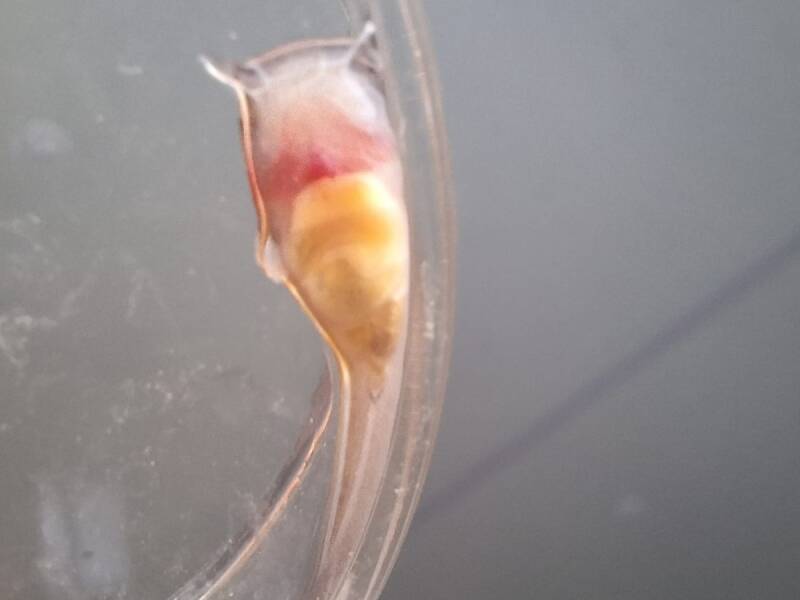
Fig. 3: Well fed larvae have full guts
## Bottleneck #5 — Weaning
The transition from live feed to dry pellet is a physiological challenge. Push it too fast and larvae refuse to eat and die. Too slow and costs stay unnecessarily high.
Begin weaning at day 5 this is the third day of feeding. Use a gradual ratio shift: 90 % live / 10 % dry, moving to 20/80 over the next 6 days.
Feed 5–6 times per day and observe your larvae closely. It is crucial to feed the right quantity. Over- and Underfeeding result in poor results.
## Bottleneck #6 — Pellet Feeding & Water Quality
Catfish fingerlings grow fast — but only if water quality keeps pace with biomass. Overfeeding without adequate filtration and water exchange causes slow growth and disease outbreaks.
Bad water quality doesn't show up as dead fish immediately — it shows up as slow growth and disease weeks later. Measure first, feed second.
## Bottleneck #7 — Grading & Cannibalism
African catfish are highly cannibalistic. A size difference of 20 % is enough for larger fish to eat smaller ones — wiping out 30–50 % of a batch within days if unmanaged.
First grading at day 14–16. Grade every 5–7 days throughout the fingerling phase. Increase feeding frequency after each grading — stress from handling triggers aggression. Cannibalism is predictable and manageable. The farms that fail are the ones that grade too late.

Fig 4. 3D Prints can be used for grading fingerlings
You Want to build this system?
Depending on the context, there are two ways we can help:
FINS4FUTURE — we support development projects with knowledge transfer, planning, and capacity building.
WEME Fishfarming — commercial hatchery solutions and knowledge transfer for farms ready to scale.


Kommentar hinzufügen
Kommentare